Learner Advice
Manual or Automatic in 2026? The Future, the Costs and the Real Answer
6 October 2026 · A1 Intensives
Quick answer: Learn in an automatic if you want to pass faster, you'll mostly drive in towns, or you plan to drive a hybrid or electric car. Learn in a manual if you want a licence that lets you drive any car, or you may need to drive a manual for work or family. Neither is "better". The best choice depends on what you'll drive in the next five to ten years.
Ten years ago, nearly everyone learned in a manual. Today that's changing fast. Whether you're 17 and booking your first lesson or returning to driving later in life, the question we hear most at A1 Intensives is:
"Should I learn manual or automatic?"
Let's answer it properly by looking at four questions:
- What's the future?
- What's best?
- What saves time and money?
- Is it skill over convenience?
Key takeaways
- About 1 in 4 UK car driving tests is now taken in an automatic, up from around 6% in 2012/13.
- New petrol and diesel cars can't be sold from 2030. Every electric car is automatic, and most hybrids are too.
- Passing in an automatic limits you to automatic cars. Passing in a manual lets you drive both.
- Automatics are often quicker to learn, but automatic pass rates have historically been lower, mainly because some learners test before they're ready.
- The cheapest licence is the one you pass first time, whichever gearbox you choose.
1. What's the future: is manual dying?
The numbers are clear. According to DVSA figures reported by the AA Driving School, only 6.1% of car tests were taken in automatics in 2012/13. By 2023/24 that had risen to 23.4%, and by 2024/25 to 26%, nearly 480,000 tests in a single year. The AA forecasts it could reach around one in three tests by 2026/27.
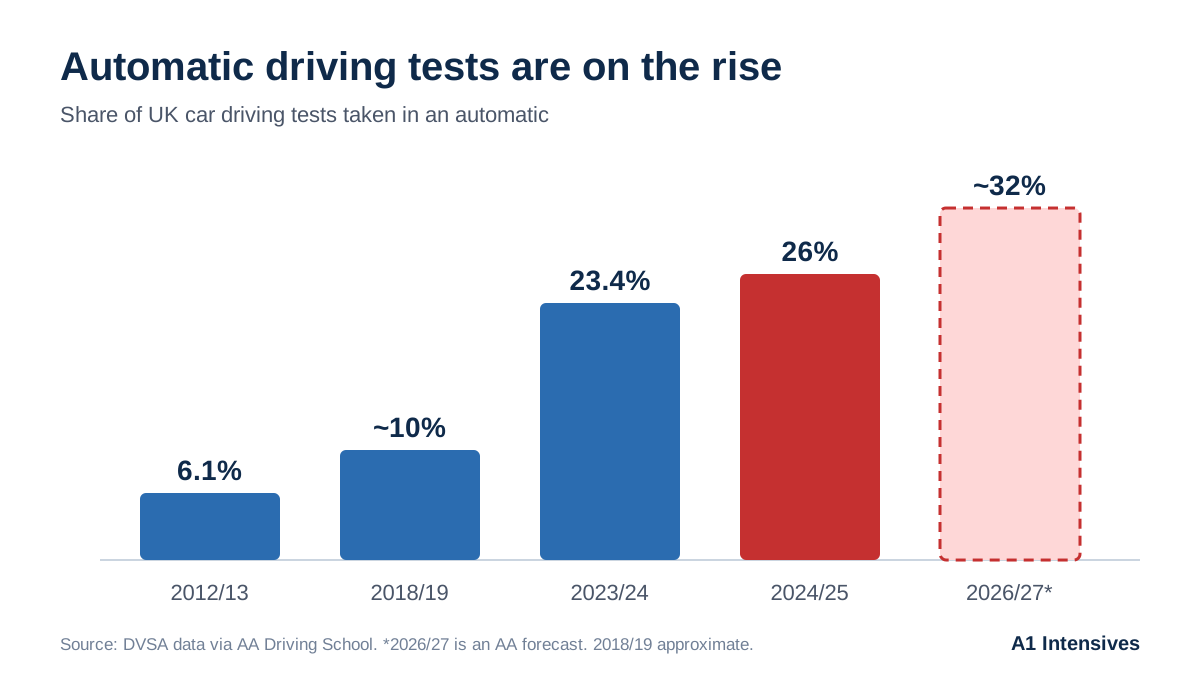 Share of UK car driving tests taken in automatics. Source: DVSA data via AA Driving School. The 2026/27 figure is a forecast.
Why is this happening?
- The 2030 ban. Sales of new petrol and diesel cars end in 2030. Full and plug-in hybrids can be sold new until 2035.
- Electric cars are all automatic. EVs don't have a gearbox you change yourself.
- Hybrids are almost always automatic too.
- Car makers are offering fewer manual models each year.
But manual isn't disappearing overnight
The ban only covers new car sales. Millions of manual petrol and diesel cars are already on UK roads, and you'll still be able to buy and drive them for years. Many affordable first cars, family cars and work vans are still manual.
Verdict: the future is automatic. But "the future" for your next car, your parents' car or your work van may still be manual for some years yet.
2. What's best for you?
There's no universal winner. It depends on your life.
| If this sounds like you… | Our suggestion |
|---|---|
| "I want my licence as quickly as possible" | Automatic |
| "My first car will be a cheap second-hand car" | Manual (cheap used cars are more often manual) |
| "I'll mostly drive in Leeds/Bradford traffic" | Automatic: stop-start traffic is far easier |
| "My job might involve driving vans or pool cars" | Manual: check with your employer first |
| "I plan to buy a hybrid or electric car" | Automatic |
| "I've struggled with clutch control before" | Automatic |
| "I want to be able to drive any car, anywhere" | Manual |
| "I'm nervous and want to focus on the road" | Automatic |
The licence difference (the most important fact)
- Pass in a manual → you can drive manual and automatic cars.
- Pass in an automatic → you can drive automatic cars only. To drive a manual later, you'd need to pass another practical test in a manual car.
The theory test is the same either way.
3. What saves time and money?
Time: automatic usually wins
Without a clutch and gears to master, you can spend lesson time on what actually gets you through the test: observation, positioning, junctions, roundabouts and hazard awareness. Many learners reach test standard in fewer hours in an automatic. This is especially true on hilly West Yorkshire roads, where hill starts in a manual take real practice.
Money: it's closer than you think
| Cost factor | Manual | Automatic |
|---|---|---|
| Hourly lesson price | Often slightly lower | Often slightly higher |
| Hours needed to reach test standard | Usually more | Often fewer |
| Test fee | £62 weekday / £75 evening, weekend | Same |
| Cheap first car (used) | More choice, often cheaper | Fewer cheap options |
| Insurance | Depends on the car, not the gearbox | Same |
| Future upgrade to drive manuals | Not needed | Another practical test |
Fewer hours at a slightly higher rate can work out about the same as, or cheaper than, more hours in a manual. The real money-saver is something else entirely:
💡 The cheapest licence is the one you pass first time. Every resit adds another test fee, more lessons and more waiting.
The pass-rate surprise
Here's something most people don't expect: historically, automatic pass rates have been lower than manual. In 2022/23 they were roughly 43% for automatic compared with 48% for manual. The likely reason is that some automatic learners book their test too early, assuming "automatic is easy".
Automatic makes car control easier. It doesn't make driving easier. You still need to read the road, judge gaps and handle complex junctions. Since the 2026 DVSA booking rules only allow two changes to a test booking, booking at the right time matters more than ever.
4. Skill over convenience?
This is the heart of the debate.
The case for skill (manual):
- You fully understand how a car works: gears, engine braking, clutch control.
- You'll never be stuck if the only car available is a manual: a hire car abroad, a friend's car, a work van.
- Many drivers feel it gives them more control, especially in snow or on steep hills.
The case for convenience (automatic):
- Less to think about means more attention for hazards, which is arguably the more important skill for safety.
- Smooth in traffic jams and city centres.
- It matches where cars are heading.
Our view at A1 Intensives: the most important driving skills, like observation, anticipation, judgement and decision-making, are exactly the same in both. A safe automatic driver is far better than an anxious manual driver. Choose the gearbox that fits your life, then focus on becoming a genuinely good driver.
Manual vs automatic on an intensive course
Both work brilliantly on an intensive driving course:
- Automatic intensive: ideal if you're starting from scratch and want to pass fast, because you can focus completely on road skills.
- Manual intensive: ideal if you've already had some manual lessons and want a full licence. Daily driving helps clutch control "click" quickly.
Not sure? We'll give you an honest recommendation after an assessment drive. Get in touch or see our courses.
FAQs
Is it worth learning manual in 2026?
Yes, if you want to drive any car or your first car is likely to be a cheaper used model. If you'll drive hybrids or EVs, automatic makes more sense.
Will manual cars be banned in the UK?
No. From 2030 new petrol and diesel cars can't be sold, but existing manual cars can still be bought, sold and driven.
Is the automatic driving test easier?
The test is identical. Automatic learners often reach test standard faster, but historically their pass rates have been lower, usually because they tested before they were truly ready.
Can I drive a manual if I pass in an automatic?
No. You'd need to pass a practical test in a manual car to upgrade your licence.
Are automatic lessons more expensive?
Often slightly per hour, but many learners need fewer hours, so the total can be similar.
Are electric cars automatic?
Yes. All electric cars are automatic, and an automatic licence covers them.